

Protecting HK's Water Quality
As a densely populated city, Hong Kong suffers from a scarcity of drinking water due to its lack of lakes, rivers and underground water, making rainwater a precious source to the city’s fresh water resources.
This is why the Government places great importance on collecting and storing rainwater.
Around one-third of the land in Hong Kong is designated as catchment areas, including 17 reservoirs with a total storage capacity of 586 million cubic metres.
Ecological balance
Due to climate change, some reservoirs may experience an excessive growth of algae, which may affect water quality. As a result, the Water Supplies Department annually releases about 300,000 fry of silver carp, bighead and mud carp into the affected reservoirs.
“The different feeding habits of these fish help reduce the algae at different depths and maintain water quality,” Water Supplies Department Artisan (Fishing) Kwok Wing-hang explained.
He added that apart from regularly conducting water quality monitoring and algae testing, the department collects water samples with the help of an unmanned surface vessel system.
“The unmanned surface vessel system is primarily used for surface water quality monitoring and sampling in reservoirs, while manned water sampling allows us to collect samples at different depths, providing more detailed data for water quality control."
Quality control
Hong Kong is one of the places in the world that enjoys the safest drinking water since the department has stringent quality control measures regarding fresh water resources. Raw water has to go through a series of rigorous treatment processes before it is delivered to citizens.
The water treatment works adapt a three-tier water quality monitoring system.
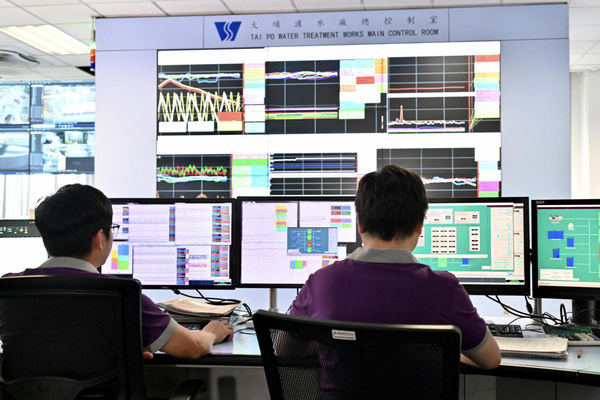
The first tier entails an online water quality monitoring system that uses sensors to continuously monitor water quality 24 hours a day at different treatment stages.
The second tier calls for on-site primary control testing, where staff at the water treatment works conduct tests on key water quality parameters to assist in adjusting chemical dosages.
The third tier involves comprehensive water quality monitoring, where water samples are regularly collected from different treatment stages for detailed physical, chemical, biological, bacteriological and radiological analyses.
The department collects about 80,000 drinking water samples and conducts over 280,000 tests annually to ensure the water quality fully complies with Hong Kong Drinking Water Standards.
Water conservation
When it comes to safeguarding Hong Kong’s water supply, the department faces two crucial challenges.
First, the impact of climate change resulting in unstable rainfall patterns in Hong Kong has affected the local yield of water supply.
In addition, to support the city’s sustained social and economic development, the demand for water is expected to grow in the future.
In response to this dilemma, the department formulated and implemented the Total Water Management Strategy in 2008. The strategy puts emphasis on containing the growth of water demand and developing new water resources.
In 2019, the department completed a review and update of the strategy, reaffirming its commitment to implement various water management measures.
Water Supplies Department Engineer Tam Ka-yan noted that due to the COVID-19 pandemic, the average domestic fresh water consumption per capita in Hong Kong, during the period from 2020 to 2022, reached around 150 litres, a rise of about 10% compared to 2019. It was therefore imperative to publicise the importance of water conservation.
In addition to ongoing water conservation promotions, Miss Tam emphasised that the department launched a new water conservation campaign in February this year and plans to establish a water conservation taskforce to provide advisory and technical support for those with ultra-high water consumption, helping them to reduce their use of water.
"With these measures, we expect to reduce the average domestic fresh water consumption to a level lower than the pre-epidemic level of 135 litres per capita."
Apart from promoting water conservation, the department is also strengthening water loss management, expanding the use of lower grade water, and implementing a desalination project.
Such measures are expected to secure a reliable water supply in Hong Kong even under an extreme drought condition.
Travel Broadens Students Horizons
Participation in Mainland study tours among special schools has skyrocketed this academic year, with the number of par... Read more
Cultivating AI Innovation On Campus
“We used simple machine learning frameworks with Python and the Raspberry Pi platform to train image classification ... Read more
Rent Aid Puts Startups On Firm Footing
A local shopping centre is not the first place you would expect to find an indoor soccer pitch, but thanks to a progra... Read more
Safeguarding Healthy Minds
“I was scared of not being able to sleep. The more I feared it, the harder it was to fall asleep. I tossed and turne... Read more
WSD Taps Into High-tech Solutions
With the Government driving innovation across departments to boost efficiency, step forward “Intelligent Arm”, a m... Read more
Food Waste Recycling Shows Growth
Food waste is far from useless. With responsible recycling, it can be recovered and redeployed. In recent years, th... Read more